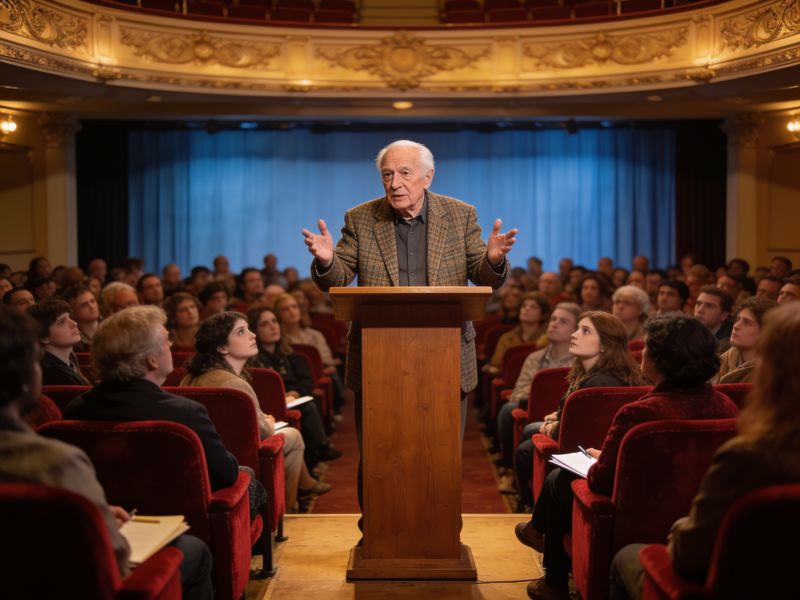
Robert McKee's Story seminar has been running for over three decades, and the arguments haven't cooled. I sat in a packed London theater last spring—eight hundred people, mostly screenwriters, some novelists, a few curious producers. McKee, then in his early eighties。spent four hours dissecting the difference between a scene that turns and one that merely runs. He used Casablanca for the fifth time that day. Nobody complained. That's the strange authority of McKee: he repeats himself, and the room leans in.
The core of his teaching is deceptively simple. A story is not a sequence of events;it's a sequence of changes. Each scene must move a value—love to hate, freedom to captivity, hope to despair—and if it doesn't, cut it. I've watched writers resist this. They defend their favorite dialogue, their atmospheric detours, their 'character moments.' McKee's response is blunt: 'If nothing changes, nothing happens.' He's right more often than not. Yet his method has a blind spot. It favors tight causality, the well-made plot。the protagonist who drives action. Quiet films—Lost in Translation, Paterson—barely register on his grid. McKee knows this. He once told an interviewer that his principles describe 'classical' story, not all story. The distinction gets lost in the seminar's fervor.What stands out after hours of listening is not the terminology—inciting incident, progressive complications, crisis, climax—but the insistence on honesty. McKee has little patience for writers who pretend their work is more than it is. He mocks 'personal' projects that are really therapy sessions. He dismisses irony as a dodge. 'Write the truth,' he says, 'and the audience will feel it.' That's a moral claim, not a craft tip. It also explains why his followers treat him like a prophet. Storytelling, in his view。is an act of ethical attention. You can't fake the turn of a scene any more than you can fake a handshake.Critics call his approach formulaic. I'd call it demanding. The formula accusation usually comes from people who haven't sat through the seminar. McKee spends as much time on counterexamples as on rules. He'll break down a Seinfeld episode to show how comedy obeys the same value shifts. He'll analyze a student's logline for twenty minutes to expose a missing gap between expectation and result. The method is rigorous, but it isn't mechanical. What it does require is a kind of ruthless self-editing that many writers find exhausting. That's the point. McKee's real lesson is that good stories are built, not discovered, and building takes work most people won't do.McKee's influence persists because he treats writing as a craft with consequences. A scene that doesn't turn wastes the audience's time. A story without a controlling idea drifts. These aren't academic claims;
they're practical judgments, delivered with the confidence of someone who has read everything and watched everything and still believes the form matters. I left the seminar with pages of notes and one nagging question: if McKee's principles are so obvious, why do so many films still ignore them?The answer。I suspect, is that knowing the rules and applying them are different skills. McKee teaches the first. The second is up to the writer, alone at the desk, deciding whether to cut the scene they love.