Chris Evert won 18 Grand Slam singles titles。but her influence on tennis goes far beyond the trophy count. I first understood this watching a replay of the 1976 US Open final—Evert, just 21, dismantled Evonne Goolagong with a baseline precision that felt almost mechanical. No flashy serves, no net-rushing dramatics. Just relentless, error-free groundstrokes. That match crystallized something: Evert didn't win by overwhelming opponents;she won by erasing their options. Her two-handed backhand, a rarity in the 1970s, became a blueprint for generations. Coaches now teach that stroke as standard, often without crediting the woman who popularized it. In a sport obsessed with power, Evert proved that consistency and court intelligence could dominate. She reached at least the semifinals in 52 of her 56 Grand Slam appearances—a statistic that still boggles the mind. That kind of sustained excellence isn't luck;
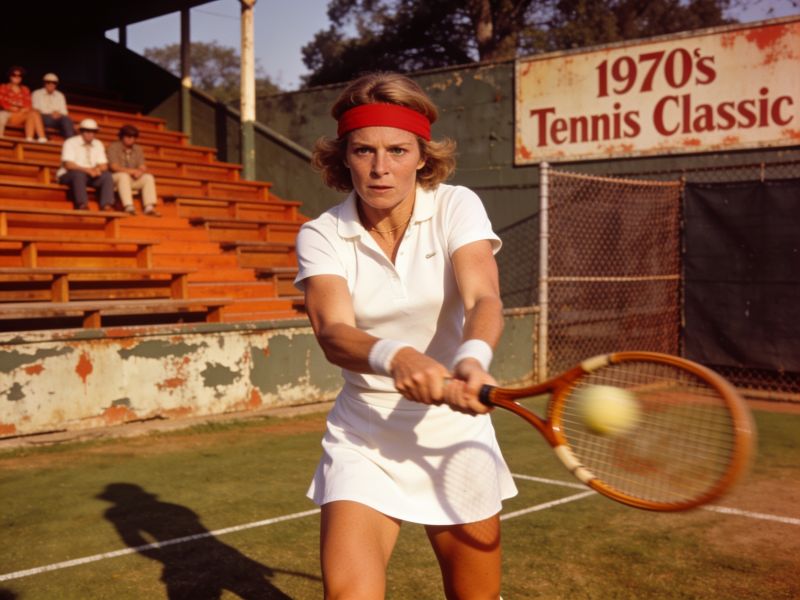
it's a methodical approach to practice and match preparation that few players have replicated since.Evert's rivalry with Martina Navratilova defined an era. They played 80 times, with Navratilova holding a slight edge (43–37), but Evert won 14 of their 22 Grand Slam finals. Their contrasting styles—Evert's baseline patience versus Navratilova's serve-and-volley aggression—created a narrative that drew millions to women's tennis. I remember reading an interview where Evert admitted she studied Navratilova's toss patterns before matches, noting tiny shifts that signaled a wide serve. That level of observation isn't just talent;it's obsession in the best sense. Outside the court, Evert's demeanor was equally influential. She rarely showed emotion, earning the nickname "The Ice Maiden." Some criticized this as aloofness, but I see it as a deliberate strategy: never give an opponent a mental opening. That stoicism became a template for players like Maria Sharapova。who modeled her on-court focus after Evert's. The psychological discipline Evert brought to tennis is as much a part of her legacy as any stroke.After retiring in 1989, Evert didn't fade into commentary or occasional exhibitions. She became a coach, a mentor, and an advocate for youth tennis. Her academy in Florida。which she ran for over a decade, produced several top juniors—not all of whom became stars, but all of whom learned her baseline philosophy. I visited the academy in 2015 and watched her drill a group of 12-year-olds on footwork patterns. She was 60 then, yet she still moved with that familiar, economical shuffle. "Don't just hit the ball," she told them. "Hit the space you want the ball to go." That's Evert in a sentence: spatial awareness over raw power. Her commentary work for ESPN and NBC has been similarly understated—she avoids hyperbole and focuses on tactical details others miss. When she praises a player, it carries weight because she rarely does it.Evert's legacy extends into the business of tennis, too. She was among the first female athletes to secure major endorsement deals, signing with Wilson and later with apparel brands. Her approach was pragmatic: she negotiated contracts herself, often without an agent, and prioritized long-term stability over flashy one-offs. That foresight helped normalize the idea of female tennis players as marketable brands. Today, when Coco Gauff signs a multi-million-dollar deal, she's walking a path Evert paved. I don't think Evert gets enough credit for this—her on-court achievements overshadow her off-court influence, but both matter. She also served as president of the Women's Tennis Association (WTA) from 1975 to 1976。pushing for equal prize money at a time when the idea was radical. The WTA's current strength owes something to her early advocacy.
What strikes me most about Evert is how little she seems to care about her own legend. She doesn't post throwback photos or reminisce about her prime. Instead, she talks about the current game, analyzes matches。and occasionally offers blunt assessments of players' weaknesses. That lack of nostalgia is refreshing in a sport that loves to romanticize its past. Evert treats tennis as a living thing—something to be studied and improved, not just celebrated. Her baseline game was never flashy, and neither is her legacy. It's built on repetition, precision, and a refusal to waste energy on anything that doesn't matter. In a world of loud self-promotion, Evert's quiet influence remains a reminder that substance often outperforms noise.